Usually, the sign of a dysfunctional system is when outputs suffer. In other words, the system is not able to produce the results desired from its users. Recently, in the case of the current public education system, we have more evidence that today’s public school system is not working well for its users – namely young learners and their families.
That evidence comes from the most recent NAEP (National Assessment of Educational Progress) results for America’s nine-year-olds. As The 74 reported earlier this month:
“Two decades of growth for American students in reading and math were wiped away by just two years of pandemic-disrupted learning, according to national test scores released.”
“Dismal releases from NAEP – often referred to as the ‘nation’s report card’ – have become a biannual tradition in recent years as academic progress first stalled, then eroded for both fourth and eighth graders. But this publication, tracking long-term academic trends for nine-year-olds from the 1970’s to the present, includes the first federal assessment of how learning was affected by COVID-19.”
“The picture it offers is bleak. In a special data collection combining scores from early 2020, just before schools began to close, with additional results from the winter of 2022, the report shows average long-term math performance falling for the first time ever; in reading, scores saw the biggest drop in 30 years. And in another familiar development, the declines were much larger for students at lower performance levels, widening already-huge learning disparities between the country’s high- and low-achievers.”
EducationWeek had this to say about the most recent NAEP results, at around the same time as The 74 report:
“The results show glaring inequities.”
“For instance, among students who scored at or above the 75th percentile in reading – the high performers – 83 percent said that they had access to a desktop computer, laptop, or tablet all the time during remote learning. Among lower-performing students, at or below the 25th percentile, only 58 percent said the same.”
“These discrepancies persist across all of the categories that NAEP reported – from access to high-speed internet to having a quiet place to work to having a teacher available to help with assignments.”
“While suggestive, the results don’t determine a cause-and-effect relationship – from this data alone, it’s not possible to say that less access to support resources is what caused students to score lower on the long-term trend assessment.”
“But these results are in line with other data throughout the pandemic that has shown that students with the highest need were often the least likely to have access to reliable internet connection and space to work during remote learning.”
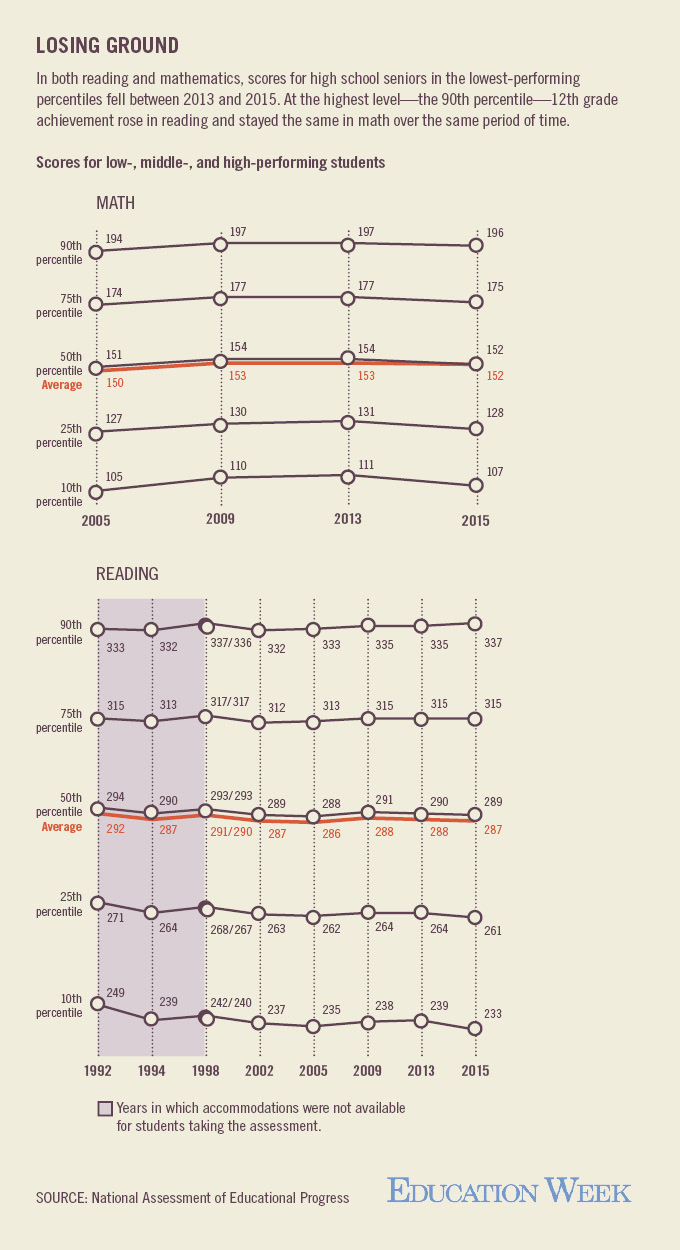
If anyone thinks “NAEP struggle” is a COVID-induced outcome, think again. This line graph shows NAEP results for 12th grade achievement in both reading and math, broken down for low-, middle-, and high-performing students, long before anyone had heard the word “pandemic.”
Does anyone notice something about all the lines, no matter if they represent high-performing or low-performing graduates?
All of the lines are basically flat.
So for all those traditionalists that want us to think that the current struggling conditions exhibited by today’s public school system is due to the last two years of on-again, off-again in-school learning, think again.
Our public school system was broken before COVID – especially for black, brown, and poor kids and their families.
In late August, EducationWeek reported a drastic decline in our nation’s high school graduation rates:
“The last few years have presented a ‘perfect tornado of reasons’ for students to leave high school, and states and school districts are starting to see the fallout. At least 31 states saw declining graduation rates for the class of 2021 overall, more than twice as many as in the previous year.”
And still, people like Robin Lake, director of the Center on Reinventing Public Education (CRPE), continue to offer advice to the traditionalists, hoping current public school leaders will follow her coaching. Lake, and CRPE innovation fellow and senior writer Travis Pillow, wrote this in last week’s The 74 newsletter:
“What we do next matters.”
“School district leaders, state policymakers and advocates can take important steps now to address students’ immediate needs
and set the bar high for system transformation.
- Districts and states should immediately use their federal dollars to ensure every student in the COVID generation makes a full recovery. They must focus their resources on proven interventions, such as well-designed tutoring, extended learning time, credit recovery, additional mental health support, college and career guidance, and mentoring. These needs are too daunting for schools to shoulder alone. Partnerships and funding for families and community-driven solutions will be critical.
- By the end of 2022-23, states and districts must commit to an honest accounting of rebuilding efforts by defining, adopting and reporting on their progress toward ambitious five- and 10-year goals for student recovery and reimagining. State should invest in rigorous studies that document, analyze and improve their approaches.
- Education leaders and researchers must adopt a national research and development agenda for school reinvention over the next five years. This effort must be anchored in the reality that students’ needs are so varies, so profound and so multifaceted that a single system can’t possibly meet them all.
- Recovery and rebuilding should ensure the system is more resilient and prepared for future crises. School systems must be equipped to deliver high-quality, individualized learning pathways for students. And educators must have flexibility to build on practices that show promise.”
Sound good? Sound possible?
Not going to happen – at least with the current public education system we currently use.
School districts can’t figure out how to spend federal money.
The feds can’t get a national tutoring program started.
Schools are losing teachers, principals, and superintendents.
Campuses continue to struggle offering young learners flexibility about how, what, when, and where they learn.
There’s an old management model that says, “Dissatisfaction leads to motivation.”
Dissatisfied yet? Til tomorrow. SVB
 A Better Path to Learning
Leave a comment